
Export Compliance in 2026: Navigating new rules, risks and responsibilities
Picture: Fatih Turan, Pexels
Finnish exporters step into 2026 facing a more demanding compliance landscape. Global sanctions regimes are shifting, dual‑use[1] classifications tightening and export‑control frameworks across major jurisdictions continue to evolve. These developments affect not only high‑tech sectors but any exporter operating in multi‑country supply chains.
I. Why Export Compliance matters in 2026
1. Less predictable trade conditions
WTO[2] data shows that global merchandise trade grew by 4.9% year‑on‑year in the first half of 2025, driven by stronger demand for AI‑related goods and companies advancing shipments ahead of expected tariff increases.
This marks a clear acceleration compared to the subdued global trade growth recorded in 2024, as highlighted in broader UNCTAD[3] reporting on weak world‑trade momentum leading into 2025.
For exporters, changes like this aren’t just numbers. They mean that:
· rules can tighten or shift with little warning, especially when governments adjust tariffs or react to developments in strategic sectors like technology, and
· customs checks and documentation demands can increase suddenly as authorities respond to rapid changes in trade patterns.
Even if products or destinations remain unchanged, compliance requirements may shift faster than expected.
2. Dual‑use and high‑tech scrutiny intensifies
Recent EU 2026 competitiveness reporting[4] and OECD 2026 economic outlook analyses[5] highlight surging demand for AI‑related components, semiconductors and advanced server equipment - categories increasingly captured by EU export controls and the updated EU Dual‑Use Regulation[6].
As technologies evolve, dual‑use lists broaden and exporters must reassess classifications more frequently.
II. What is changing
1. Stricter screening across technology‑linked sectors
Electronics, telecommunications equipment and data‑infrastructure components now face expanded licensing and end‑use scrutiny as export controls become a structural part of the EU trade environment. The EU’s 2026 competitiveness report notes that strategic sectors are increasingly affected by heightened controls and supply‑chain monitoring.
2. More complex sanctions regimes
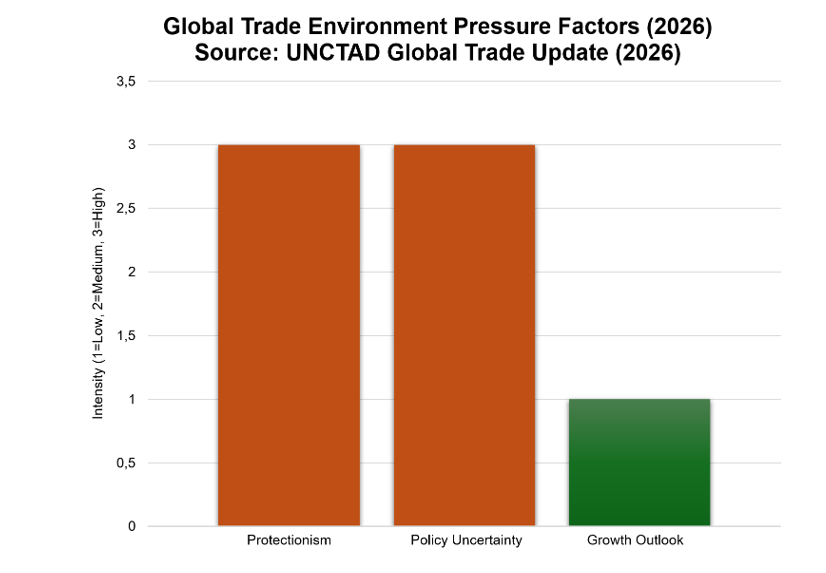
Recent UNCTAD[7] and ICC reporting[8] shows that global protectionism - rising use of tariffs, export controls and other restrictive policies - combined with diverging national measures is adding administrative burden for exporters. Companies must adapt to more frequent rule changes, higher documentation demands and evolving sanctions obligations, all of which increase day‑to‑day compliance work.
3. Fragmentation creating operational risk
As jurisdictions update rules independently, exporters must navigate overlapping regulatory frameworks across markets. This raises the likelihood of accidental breaches and complicates compliance planning.
III. What Finnish companies need to pay attention to
1. Finland’s high‑tech export profile
Finland exports machinery, specialised equipment, electronics and technical components - all these areas are vulnerable to dual‑use classification adjustments.
2. Third‑country supply chain exposure
Even when the direct export destination is fully compliant, intermediaries or distributors in other markets can introduce hidden sanctions exposure.
3. Greater documentation expectations
Regulators increasingly expect:
· detailed classification reasoning,
· verified end‑use statements,
· clearer visibility into distribution chains.
IV. Practical guidance for Finnish exporters
1. Risk‑score export destinations
Systematically assess destination risks based on sanctions alignment, sector controls and end‑use uncertainty[9].
2. Segment products beyond the obvious
Evaluate items with technical features that could unintentionally fall under dual‑use or emerging‑technology controls[10].
3. Strengthen internal compliance routines
Clear escalation pathways, regular reviews and red‑flag training help businesses act early rather than respond after issues appear.
4. Know when outside expertise is justified
This isn’t a sales pitch - just a fact: complex supply chains or technical classifications may require specialist review to ensure consistency across regimes.
V. Closing perspective
Export compliance in 2026 is no longer a routine task. It is a strategic function that protects market access, prevents disruptions and supports long‑term international growth. Finnish companies that anticipate rather than react - by recognising emerging risks, documenting decisions clearly, and monitoring evolving regulations - will be best positioned to navigate the year ahead.

Nora Haapala
Attorney-at-law
Associate Partner
Rödl Attorneys Ltd.
[1] Goods, software and technologies that have legitimate civilian applications but can also be used for military or security‑related purposes, and are therefore subject to export control regulation
[2] World Trade Organization - the intergovernmental body that administers and oversees the global system of multilateral trade rules.
[3] The United Nations Conference on Trade and Development - is a UN agency responsible for monitoring and analysing global trade and development trends, including trade growth, policy shifts and economic vulnerabilities.
[4] EUR-Lex - 52026DC0046 - EN - EUR-Lex
[6] Regulation (EU) 2021/821 of the European Parliament and of the Council of 20 May 2021 setting up a Union regime for the control of exports, brokering, technical assistance, transit and transfer of dual-use items
[7] https://unctad.org/system/files/official-document/ditcinf2025d11_en.pdf
[8] Multilateral trade - ICC - International Chamber of Commerce
[9] The degree of risk that the exported item could be used for a purpose that is restricted, sensitive or different from what the buyer declared
[10] Emerging‑technology controls refer to export restrictions on fast‑developing technologies - such as advanced AI, high‑performance computing, semiconductor tools, quantum‑related systems, and autonomous capabilities - that may not yet be fully listed as dual‑use items but are considered strategically sensitive.